This guide contains affiliate links. If you book through them we earn a small commission at no extra cost to you. I only recommend hotels I’ve researched deeply and genuinely rate.
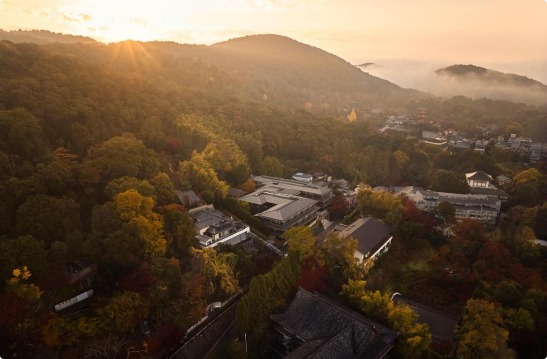
Kyoto’s 5-star shelf has roughly doubled in the last six years. Aman landed in 2019; Banyan Tree, Six Senses, Dusit Thani, Roku Kyoto, Capella and the Imperial Hotel all opened inside a five-year stretch — and the Ritz / Four Seasons / Park Hyatt trio carried on without blinking. Eighteen serious luxury properties now compete for the same traveller, and the gap between what’s marketed as luxury and what’s actually worth the money has stretched wider than it used to be.
This is my current 18-hotel shortlist. Four classic flagships, the major 2020–2024 openings, three design-led boutiques, the Arashiyama riverside field (HOSHINOYA, Suiran, Seiryu), and the machiya and countryside options that don’t fit neatly elsewhere. I’ll tell you which ones I think are worth the money and which ones are coasting on brand.
In This Article
- Quick-Reference Table
- How to Choose Your Luxury Kyoto Hotel
- Peak-Season Pricing at the Luxury Tier
- The Big-Brand Flagships
- Aman Kyoto — The Forest Retreat
- The Ritz-Carlton, Kyoto — Riverside Urban Flagship
- Four Seasons Hotel Kyoto — Heritage Pond Garden
- Park Hyatt Kyoto — The Yasaka Pagoda View
- The Newer Luxury Collection Openings
- Hotel The Mitsui Kyoto — Luxury Collection Flagship
- Six Senses Kyoto — Wellness-First Luxury
- Banyan Tree Higashiyama Kyoto — The 2024 Hilltop
- Roku Kyoto, LXR — Private In-Room Onsen
- Capella Kyoto — Miyagawa-cho Machiya Luxury
- Design-Led Boutique Luxury
- The Shinmonzen — 9-Room Architect-Led Boutique
- Saka Hotel Kyoto — Restrained 26-Room Boutique
- Hotel The Celestine Kyoto Gion — Mid-Tier Luxury for Gion Walkers
- Arashiyama Riverside & Heritage
- HOSHINOYA Kyoto — Boat-Arrival Riverside Ryokan
- Suiran, a Luxury Collection Hotel — Arashiyama Private-Onsen Rooms
- The Hotel Seiryu Kyoto Kiyomizu — 1933 Schoolhouse Conversion
- Machiya & Countryside Luxury
- Maana Kiyomizu — Whole-House Machiya
- Moksa Rebirth Hotel — Mount Hiei Countryside
- Ryokan Sumiya Kihoan — Countryside Luxury Ryokan, Kameoka
- What Most Luxury Guides Get Wrong
- Which Hotel for Which Trip
- Frequently Asked Questions
- What’s the best 5-star hotel in Kyoto?
- Is Aman Kyoto worth it?
- Which luxury hotels in Kyoto have real onsen?
- How far ahead do I need to book luxury Kyoto hotels for cherry-blossom season?
- What’s the best hotel for a honeymoon in Kyoto?
- Is HOSHINOYA Kyoto on Booking.com?
- Which luxury Kyoto hotels have Michelin-starred restaurants?
- What’s the best garden hotel in Kyoto?
- What to Read Next
Quick-Reference Table
If you only need the headline answer for your trip, start here. Full write-ups, fact blocks and pros/cons for every entry are below.
| Hotel | Category | Best For | From/night | Book |
|---|---|---|---|---|
| Aman Kyoto | Big-brand flagship | Once-in-a-lifetime forest retreat | ¥260,000 | aman.com |
| The Ritz-Carlton Kyoto | Big-brand flagship | Riverside urban luxury, anniversaries | ¥280,000 | Check prices |
| Four Seasons Hotel Kyoto | Big-brand flagship | Garden-first travellers | ¥160,000 | Check prices |
| Park Hyatt Kyoto | Big-brand flagship | Pagoda view, honeymoons | ¥180,000 | Check prices |
| Hotel The Mitsui Kyoto | 2020s opening | First 5-star Kyoto stay with real onsen | ¥95,000 | Check prices |
| Six Senses Kyoto | 2020s opening | Wellness-first stays | ¥110,000 | Check prices |
| Banyan Tree Higashiyama Kyoto | 2020s opening | Hilltop views, funicular arrival | ¥130,000 | Check prices |
| Roku Kyoto, LXR | 2020s opening | Private in-room onsen | ¥85,000 | Check prices |
| Capella Kyoto | 2020s opening | Miyagawa-cho machiya-format luxury | ¥230,000 | Check prices |
| The Shinmonzen | Design boutique | Design obsessives, architecture trips | ¥180,000 | theshinmonzen.com |
| Saka Hotel Kyoto | Design boutique | Small-scale luxury, no big-brand gloss | ¥65,000 | Check prices |
| Hotel The Celestine Kyoto Gion | Design boutique | Gion walkers on a tighter luxury budget | ¥55,000 | Check prices |
| HOSHINOYA Kyoto | Arashiyama riverside | Boat-arrival retreat, two-night minimums | ¥160,000 | hoshinoresorts.com |
| Suiran, a Luxury Collection | Arashiyama riverside | Arashiyama base with private onsen rooms | ¥95,000 | Check prices |
| The Hotel Seiryu Kyoto Kiyomizu | Heritage conversion | Kiyomizu-dera morning walks | ¥85,000 | Check prices |
| Maana Kiyomizu | Whole-house machiya | Couples or small groups booking a whole house | ¥110,000 | Check prices |
| Moksa Rebirth Hotel | Countryside | Mount Hiei escape, slow-retreat stays | ¥70,000 | Check prices |
| Ryokan Sumiya Kihoan | Countryside ryokan | One-night luxury ryokan detour | ¥55,000 pp | Check prices |
How to Choose Your Luxury Kyoto Hotel
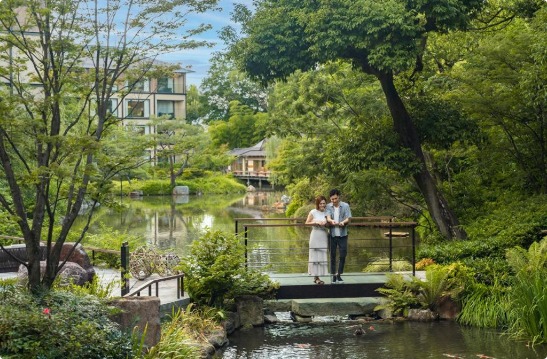
Kyoto luxury is not Tokyo luxury. You won’t find 80th-floor skyline views or flashy brand theatrics — what you get instead is quieter. Most first-time luxury travellers to Kyoto misbook because they haven’t thought about which axis matters. Pick that first, the hotel second:
- Garden vs view vs onsen vs design vs countryside. These are the five things Kyoto luxury competes on, and it’s rare to get more than two. Four Seasons wins on garden. Park Hyatt wins on view. Roku Kyoto and Sumiya Kihoan win on real onsen water. Shinmonzen wins on design. HOSHINOYA and Aman win on countryside-inside-the-city.
- Central vs peripheral. Central means Nakagyo, Gion, Higashiyama downtown — you walk to dinner in Pontocho. Peripheral means Aman, Roku, Moksa, HOSHINOYA. Peripheral gives you silence, gardens and real onsen; it also locks you into eating at the hotel most nights.
- Real hot-spring water vs “spa bath”. Most central-Kyoto hotel onsen are heated mineral baths, not onsen. The Mitsui trucks water from Arima; Roku has its own well in Kinugasa; Suiran has a natural spring in Arashiyama; Sumiya Kihoan has its own source in Kameoka. If genuine onsen matters, those four are your list.
- Book the room category above standard. This matters more in Kyoto than anywhere else. Standard rooms at Park Hyatt, Four Seasons and Banyan Tree lose the view, the garden or the terrace that’s the whole point of the hotel. Skip one night and book up a category rather than staying two nights in the wrong room type.
Peak-Season Pricing at the Luxury Tier
Luxury rates in Kyoto move more violently than in any other Japanese city. Knowing the rough multipliers keeps you from overpaying or assuming a property is “sold out” when it’s just expensive.
- Cherry-blossom peak (late March to early April): 2.5x to 4x rack rates at Ritz-Carlton, Four Seasons, Aman and HOSHINOYA. Book nine months ahead for the two-week window. The weekend inside peak sakura is often the single most expensive night of the Japanese calendar.
- Autumn leaves (mid- to late November): 2x to 3x rack. Kiyomizu-dera hotels (Celestine, Seiryu, Saka) get hit hardest because of the Kodai-ji night-illumination traffic.
- Golden Week (late April to early May): 1.8x to 2.5x and near zero availability at the top tier. Domestic Japanese luxury travel fills these rooms fast.
- Gion Matsuri (mid-July): 1.5x to 2x around the Yoiyama evenings and the parade. Downtown hotels (Mitsui, Shinmonzen, Celestine) matter here; outlying ones (Aman, Roku, Moksa) barely move.
- Sunday to Tuesday year-round: roughly 25–35% cheaper than Friday–Saturday. If your trip is flexible, anchor midweek.
- January and early February: the genuine low season. Rates can fall 40% below spring peaks. The trade-off is weather — Kyoto winters get colder than people expect.
The Big-Brand Flagships
These are the four properties that define the category. They’re all more than eight years old at this point, which in Kyoto terms makes them the establishment. Each has a specific angle — forest, river, garden, view — and none of them tries to be the others.
Aman Kyoto — The Forest Retreat
Location: Takagamine hills, northern Kyoto
Nearest station: Kitaoji (Karasuma line) — 25 min by taxi, not walkable
To central Kyoto: 25 min by taxi
Best for: Once-in-a-lifetime stay; a night where the city disappears
From: ¥260,000/night (standard), two-night minimum
Book: Direct only — aman.com (not listed on Booking.com)
Aman Kyoto sits on a forested estate in the Takagamine hills north of the city. The grounds had been cultivated as moss gardens, streams and stone paths for decades before the hotel built anything. Kerry Hill’s architectural brief was minimum disturbance — 26 pavilion rooms and a low stone bathhouse arranged along paths that feel like a private forest rather than a hotel footprint. Arrival is a long quiet walk through moss gardens. Breakfast runs 90 minutes if you let it. The spa has its own onsen pool, and service is the kind of long-tenure attention where the general manager remembers your coffee order by day two.
Who it’s not for: anyone planning a temple-and-dinner-focused four-day first Kyoto trip. You’ll lose 50 minutes of taxi time every time you leave and come back, and the property quietly encourages you not to leave at all.
What’s good:
- Genuine forest silence inside the city boundary — rare in any Japanese hotel
- On-site onsen with piped spring water, not a heated mineral bath
- Service consistency comparable to Aman Tokyo and better than any brand competitor in Kyoto
What’s not:
- 25-minute taxi from anywhere you’re probably sightseeing
- Two-night minimum and direct-only booking means no last-minute Booking.com comparison; you’re committing before you can stress-test the price
→ Check availability at Aman Kyoto direct (not on Booking.com)
The Ritz-Carlton, Kyoto — Riverside Urban Flagship
Location: Nakagyo-ku, west bank of the Kamo River near Nijo-Oike
Nearest station: Kyoto Shiyakusho-mae (Tozai line) — 3 min walk
To Gion: 15 min walk across the Kamo
Best for: Urban luxury with river views; anniversary or milestone stays
From: ¥280,000/night
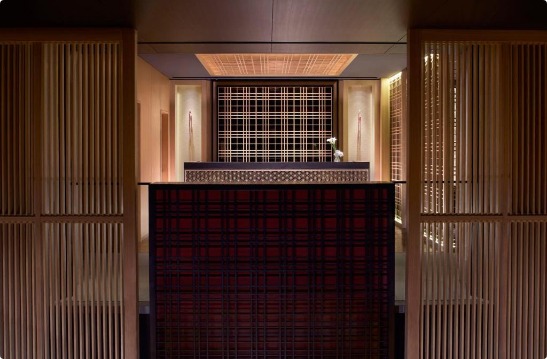
The Ritz is the grandest urban luxury option in Kyoto, on the west bank of the Kamo River with the Higashiyama ridge in direct east-facing view. The river-view category on the upper floors gives you one of the better morning window seats of any hotel in the city. The building is deliberately low-profile and black-tiled — you’ll almost miss it from the street. Inside: dark wood, tatami-edged corners, and the Michelin-starred Mizuki for kaiseki. Service is Ritz-formal, which some people love and some find airless. The pool is excellent. The spa does Japanese treatments without leaning on hotel-spa clichés. If you want personality and edge, look at Shinmonzen or Aman; if you want urban luxury with zero surprises and a river view you’d actively choose, this is the category-defining option. The Tozai subway exit is 3 minutes away. Book a river-view Deluxe category minimum — the standard rooms lose the river, which is the whole reason to stay here.
What’s good:
- Upper-floor river-view rooms overlook the Kamo and the Higashiyama ridge — your best hotel-window view in central Kyoto
- Mizuki (Michelin-starred kaiseki) and the basement sushi counter both serve in-hotel dinners that stand up to outside Kyoto restaurants
- Spa is one of the strongest in Japan at the urban-hotel tier — the Japanese-ingredient treatments aren’t marketing fluff
What’s not:
- Standard rooms lose the river view entirely; you need to book Deluxe or above for the thing you’re paying for
- Service is faultless but formal; you might want personality rather than polish
→ Check prices at The Ritz-Carlton Kyoto on Booking.com
Four Seasons Hotel Kyoto — Heritage Pond Garden
Location: Southern Higashiyama, next to Sanjusangen-do
Nearest station: Shichijo (Keihan line) — 10 min walk
To Gion: 25 min walk or 10 min by taxi
Best for: Garden-first travellers; the quietest soundscape of any Kyoto 5-star
From: ¥160,000/night
The Four Seasons wraps around Shakusui-en, a restored pond garden the hotel dates to the Heian period. That’s the whole pitch, and it works — the pond-view category looks onto mature maples, a koi pond and a stone path that wouldn’t be out of place in one of the UNESCO temples nearby. Building the hotel around the garden rather than paving over it gives the property one of the quieter soundscapes among the city’s 5-stars. The spa is among the better ones in Japan — the hinoki cedar bath and steam room actually get used, not just photographed. Brasserie does breakfast better than most Michelin hotel breakfast services; the omelette station is annoyingly consistent. Location-wise you’re in southern Higashiyama, so Gion and Kiyomizu are a taxi ride rather than a walk. For a garden-anchored trip that’s a feature, not a bug — Sanjusangen-do (1,001 gilded Kannon statues) is a 3-minute walk and almost nobody staying at the hotel bothers.
What’s good:
- Pond-view rooms overlooking Shakusui-en feel like you’re staying inside a temple garden
- Spa is used and not decorative — especially the hinoki bath and the Japanese-style treatments
- Sanjusangen-do, an under-touristed heritage site, is a 3-minute walk from the lobby
What’s not:
- You’ll taxi everywhere in Gion and central Kyoto — not a walk-to-dinner location
- Standard rooms lose the pond view; book the Garden or Garden Premier category
→ Check prices at Four Seasons Hotel Kyoto on Booking.com
Park Hyatt Kyoto — The Yasaka Pagoda View
Location: Upper Higashiyama, near Yasaka Pagoda and Kodai-ji
Nearest station: Kiyomizu-Gojo (Keihan line) — 15 min uphill walk
To Gion Shijo: 15 min walk
Best for: View-seekers; honeymoons; hillside walkers
From: ¥180,000/night
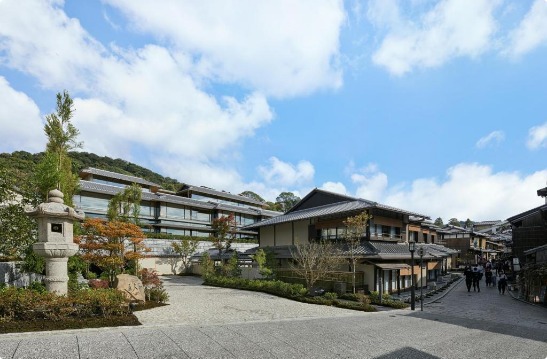
Park Hyatt sits on the upper Higashiyama slopes, two minutes on foot from Yasaka Pagoda. West-facing upper-category rooms look over the rooftops of southern Kyoto with the pagoda axis in the foreground — one of the single best hotel windows in the city. The entry-level rooms lose this view to the inner courtyard, worth knowing before you book. Architecture is Park Hyatt’s usual understated Japanese aesthetic — pale wood, charcoal textiles, no bling. The Kyoto Bistro does a reliably strong dinner and the terrace bar at sundown is underrated. Arrival is an uphill walk from any subway; taxi rather than walk with luggage. In exchange you can step out at 6am and be the first one at Yasaka Pagoda and Ninenzaka, a window of maybe 90 minutes before the crowds arrive. The 360-year-old Kyoyamato teahouse on the property runs a kaiseki service that’s good but not category-defining; if you have one kaiseki meal in Kyoto, spend it outside the hotel.
What’s good:
- Upper-category west-facing rooms overlook Yasaka Pagoda and southern Kyoto — genuinely hard to replicate anywhere else at this scale
- Two minutes on foot from the Yasaka Pagoda photograph spot; dawn walks before the crowds arrive are a real benefit
- Park Hyatt service in the Tokyo mode, which suits returning Japan travellers
What’s not:
- Luggage arrival is uphill from any station — you’ll taxi rather than walk in
- Entry-level rooms lose the signature view; book Deluxe or higher
→ Check prices at Park Hyatt Kyoto on Booking.com
The Newer Luxury Collection Openings
Five hotels opened between 2020 and 2024 that have already pushed the Ritz / Four Seasons / Park Hyatt trio into a more crowded field. Each is genuinely different from the old guard — and from each other.
Hotel The Mitsui Kyoto — Luxury Collection Flagship
Location: Nakagyo-ku, directly across from Nijo Castle
Nearest station: Nijojo-mae (Tozai line) — 2 min walk
To Kyoto Station: 15 min by taxi
Best for: First 5-star Kyoto stay with real onsen; wellness-leaning families
From: ¥95,000/night
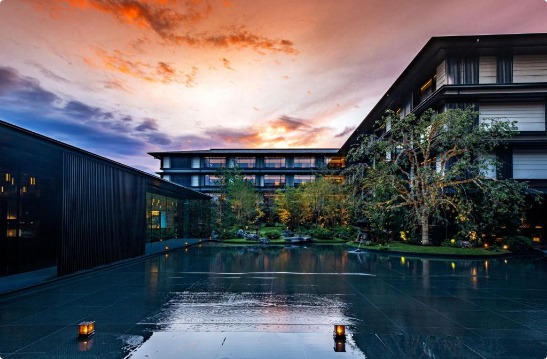
The Mitsui occupies the former estate of the Mitsui zaibatsu family, facing Nijo Castle across the moat. The original residence was demolished; the garden was preserved and the 161-room hotel was built around it by André Fu. The central lobby looks onto an old maple that survived the rebuild. Rooms run 42 to 72 square metres — larger than the Kyoto average — and the Garden Bath suites on the upper floors have open-air private tubs overlooking the inner courtyard. The bathhouse is the hotel’s unusual draw: water is piped in from Arima Onsen in Hyogo — a real hot-spring source rather than a heated mineral bath — which makes the Mitsui one of the few central Kyoto hotels where the word “onsen” is technically accurate. The spa attached is among the better hotel spas in the city. The French-Japanese fusion restaurant (Forni) is fine but skippable; the casual Toki does a better version of Kyoto-style cuisine without the ceremony.
What’s good:
- Real hot-spring water in the central city — piped from Arima rather than a heated mineral bath
- Rooms are 20–30% larger than the Kyoto 5-star average, which matters for longer stays
- Nijojo-mae subway is a 2-minute walk — luggage arrival is easy
What’s not:
- The in-hotel fine-dining restaurant is good but not a reason to stay in for kaiseki
- You’re facing Nijo Castle, not central Gion or Pontocho — dinner out is a short taxi
→ Check prices at Hotel The Mitsui Kyoto on Booking.com
Six Senses Kyoto — Wellness-First Luxury
Location: Higashiyama, south of Toyokuni-jinja
Nearest station: Shichijo (Keihan line) — 10 min walk
To Gion Shijo: 25 min walk or 10 min by taxi
Best for: Wellness stays; travellers who actually use a spa
From: ¥110,000/night
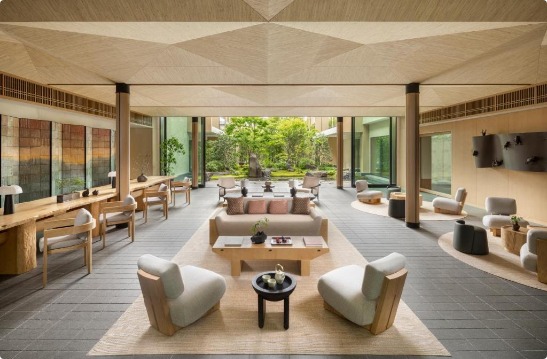
Six Senses opened in 2024 and brought the chain’s wellness-first approach to a quieter corner of Higashiyama. 81 rooms, a large spa with hinoki ofuro baths in the spa suites, a Watsu pool (uncommon in Kyoto hotels), and a central reflecting pond that most rooms overlook. Rooms themselves are in the chain’s pale-wood-and-thick-textiles mode — elegantly simple rather than distinctly Kyoto. Book this one if you’re going to use the wellness programme seriously; the breathwork sessions and Japanese-tradition spa packages are less performative than at most wellness properties. The Earth Lab cultural programme (whisky tastings, sensu-fan painting, Zen garden instruction) is substantive rather than filler. Sekki, the restaurant, leans into Japan’s 24-season calendar without overdoing it. You’re 10–15 minutes on foot from the main Higashiyama temple corridor — but the quiet is part of what you’re paying for.
What’s good:
- The spa is one of the few in Kyoto that’s genuinely used for treatments rather than photographs — Watsu pool, proper hinoki ofuro, well-run Japanese wellness menu
- The Earth Lab cultural programming (whisky tasting, tea rituals, Zen garden instruction) is substantive
- Rooms overlook either the Toyokuni Shrine grounds or the inner courtyard pond, not a street
What’s not:
- Rooms are contemporary rather than distinctly Kyoto — less architectural personality than Shinmonzen or Mitsui
- 15 minutes on foot from the main Higashiyama temple corridor — walkable but not front-row
→ Check prices at Six Senses Kyoto on Booking.com
Banyan Tree Higashiyama Kyoto — The 2024 Hilltop
Location: Shogun-zuka hilltop, east of Higashiyama
Nearest station: Keage (Tozai line) — 20 min taxi via funicular road
To Gion: 15 min by taxi down the hill
Best for: Big-ticket views; hillside luxury; design-first stays
From: ¥130,000/night
Banyan Tree Higashiyama opened in 2024 on the Shogun-zuka hilltop east of Higashiyama — an unusual site in a city that mostly builds luxury at street level. The hotel is accessed via a small funicular from a lower gate, and the hillside terrace looks west across central Kyoto toward the Nishiyama ridge. 52 rooms, all with private outdoor terraces, Kengo Kuma’s latticed-wood architectural signature throughout, and a lobby bar with what I think is among the better sunset views from any hotel in the city. The isolation is the defining feature and the defining cost: getting down to Gion or downtown for dinner means the funicular plus a 15-minute taxi, so you’ll default to eating at the hotel. Ryozen, the on-site Japanese restaurant, is unusually strong for an in-hotel option — but if your trip is about evenings in Pontocho, Banyan Tree will fight you on logistics. If it’s about two or three quiet days above the city, it’s hard to beat.
What’s good:
- Sunset view from the lobby bar across central Kyoto is among the best hotel views in the city for that specific axis
- Every room has a private outdoor terrace, not just the suites
- On-site restaurant Ryozen is strong enough that eating in isn’t a compromise
What’s not:
- Funicular plus taxi to reach dinner in Gion means you’ll likely eat in most nights
- Standard rooms have terraces but lose the west-facing city view — book a city-view category
→ Check prices at Banyan Tree Higashiyama Kyoto on Booking.com
Roku Kyoto, LXR — Private In-Room Onsen
Location: Kinugasa, northern Kyoto (near Kinkaku-ji)
Nearest station: Kitaoji (Karasuma line) — 15 min by bus or taxi
To central Kyoto: 15 min by taxi
Best for: Private-onsen luxury; temple-focused trips; honeymoons
From: ¥85,000/night
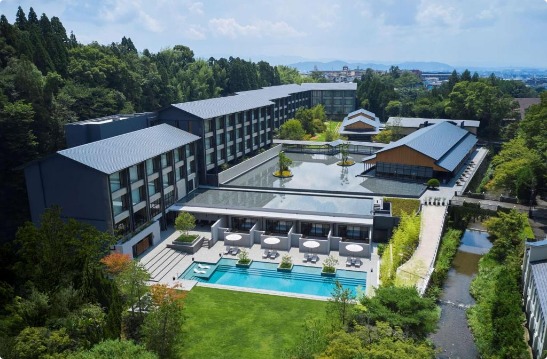
Roku Kyoto, part of Hilton’s LXR boutique-luxury line, sits in northern Kyoto in an area that sees far fewer tourists than Higashiyama. The defining feature: every one of the 114 rooms has a private open-air balcony onsen, fed from the property’s own natural hot-spring well. Real spring water in a private room bath at this scale is unusual in the city. The trade-off is geography — you’re 15 minutes by taxi from central Kyoto, so dinner means a taxi or bus rather than a walk. But Genkoan Temple (the “window of enlightenment” viewing spot) is a 2-minute walk, Kinkaku-ji is a short drive, and the northern temple cluster — Ryoan-ji, Ninna-ji, Daitoku-ji — is far more walkable from here than from Gion. If your trip is temple-heavy in northern Kyoto, this saves real time every morning.
What’s good:
- Every room has a private open-air onsen with real hot-spring water — not a mineral bath
- Proximity to Genkoan, Kinkaku-ji, Ryoan-ji saves you the 40-minute cross-city taxi in the morning
- Outdoor hot-spring swimming pool on the property — unusual in Kyoto hotels
What’s not:
- You’ll taxi or bus to any dinner in central Kyoto — not a walk-out location
- Rooms are contemporary rather than distinctly traditional; if you want a machiya aesthetic, look at Capella or Maana
→ Check prices at Roku Kyoto LXR on Booking.com
Capella Kyoto — Miyagawa-cho Machiya Luxury
Location: Miyagawa-cho, just south of Gion
Nearest station: Gion Shijo (Keihan line) — 5 min walk
To Kenninji temple: 3 min walk
Best for: Machiya aesthetic, compact room counts, Kenninji proximity
From: ¥230,000/night
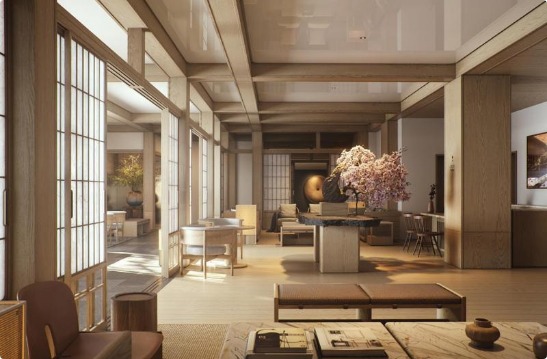
Capella Kyoto opened in late 2024 inside a reimagined machiya in Miyagawa-cho, just south of Gion proper. Steps from Kenninji — founded in 1202 and Kyoto’s oldest Zen temple — and the Kaburenjo theatre where Miyagawa-cho’s geiko perform Kyo-odori each spring. Tiny by big-brand standards (52 rooms) and priced at the top of the category. The immersive programme is the thing to book for: Capella runs visits to centuries-old lacquerware workshops, incense rituals, and Kyomai dance demonstrations on the lobby stage, all included experiences rather than add-ons. SoNoMa by SingleThread is the first Japanese outpost of Healdsburg’s three-Michelin-star restaurant; even if you don’t eat there, it sets the tone. Rooms have shoji screens and hinoki soaking tubs in the ryokan manner.
What’s good:
- Kenninji (Kyoto’s oldest Zen temple) is a 3-minute walk — dawn visits before 8am are a real experience
- SoNoMa by SingleThread is a genuine culinary draw, not just a hotel restaurant
- Immersive-culture programme (incense rituals, lacquerware workshop visits, Kyomai dance) is included and substantive
What’s not:
- Priced well above Mitsui and Six Senses for a comparable room footprint — you’re paying for the Miyagawa-cho location and the brand
- Bar stays open late, which is great or not depending on which floor you’re on
→ Check prices at Capella Kyoto on Booking.com
Design-Led Boutique Luxury
Three properties that compete on architectural or service quality rather than brand name. Two are small (9 rooms, 26 rooms); the third is bigger but distinct from the Ritz / Four Seasons / Park Hyatt formula.
The Shinmonzen — 9-Room Architect-Led Boutique
Location: Gion, Shinmonzen-dori antique-shop street
Nearest station: Gion Shijo (Keihan line) — 7 min walk
To Yasaka Shrine: 5 min walk
Best for: Design-obsessed travellers; architecture trips; serious-dining stays
From: ¥180,000/night
Book: Direct only — theshinmonzen.com
The Shinmonzen is a nine-room property designed by Tadao Ando (several guides mistakenly credit Kengo Kuma — the hotel’s own website confirms Ando) for hotelier Paddy McKillen. It sits on a narrow Gion lane next to a row of classical antique shops. The building is the point: cedar slats, black steel, a small interior courtyard, bespoke fixtures in every suite. Every room is individually designed; the top-floor ones have terraces with private garden baths overlooking the Shirakawa stream. The restaurant is Jean-Georges Vongerichten’s first Japanese outpost, with a 3,000-bottle wine cellar — rooms and dining are priced at the extreme top of the category. Reservations are closer to a concierge conversation than a Booking.com checkout; email exchange rather than instant confirmation. Nine rooms means booking six to nine months out for spring and autumn.
What’s good:
- Nine rooms and staff continuity that more closely matches a private-house service model
- Jean-Georges Kyoto is a genuine dining destination, not a hotel restaurant with a famous name attached
- Tadao Ando architecture that you can spend a weekend inside — rare at this format
What’s not:
- Direct booking only, no Booking.com comparison; rates are what they are
- Availability is aggressive — nine rooms vs city demand means spring and autumn book six months out
→ The Shinmonzen direct (not on Booking.com)
Saka Hotel Kyoto — Restrained 26-Room Boutique
Location: Higashiyama, Ninenzaka area
Nearest station: Kiyomizu-Gojo (Keihan line) — 10 min walk uphill
To Kiyomizu-dera: 5 min walk
Best for: Travellers wanting design quality without big-brand polish
From: ¥65,000/night
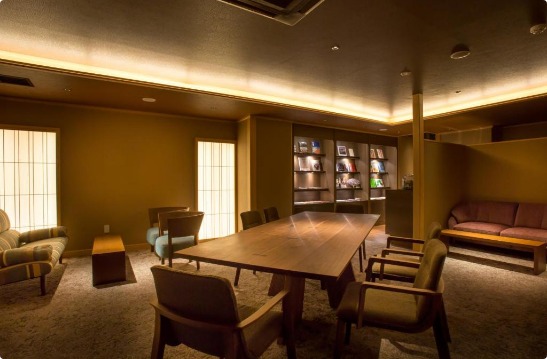
Saka is a 26-room boutique in Higashiyama, a short walk uphill from Ninenzaka and a short stone-step climb to Kiyomizu-dera. One of the quieter entries in the new luxury wave — owned by a Kyoto family who run a well-regarded kaiseki restaurant (Saka-no-ue) downstairs. The architectural approach is restraint rather than statement. Rooms mix traditional tatami nooks with Western beds, hinoki soaking tubs, and floor-to-ceiling glass onto small inner courtyards. Dinner at Saka-no-ue counts toward the hotel kaiseki service, and the small-batch in-room breakfast is better than most 5-star buffets. Saka isn’t trying to be HOSHINOYA or Aman, and that’s the appeal — luxury at 26-room scale without the production-value inflation, at well under ¥80,000 a night outside peak season.
What’s good:
- Saka-no-ue kaiseki downstairs is the hotel’s own restaurant; the meal plan is actually good value
- 5-minute walk to Kiyomizu-dera means you can be through the gate at 6:30am before the crowds
- Genuinely small — 26 rooms, family-run — which shows in service consistency
What’s not:
- No spa to speak of; if you want a spa programme, look at Mitsui or Six Senses
- Uphill walk from the nearest subway with luggage — taxi in rather than walk
→ Check prices at Saka Hotel Kyoto on Booking.com
Hotel The Celestine Kyoto Gion — Mid-Tier Luxury for Gion Walkers
Location: Higashiyama, edge of Gion
Nearest station: Gion Shijo (Keihan line) — 10 min walk
To Yasaka Shrine: 8 min walk
Best for: Gion-first stays that don’t need a brand-flagship price tag
From: ¥55,000/night
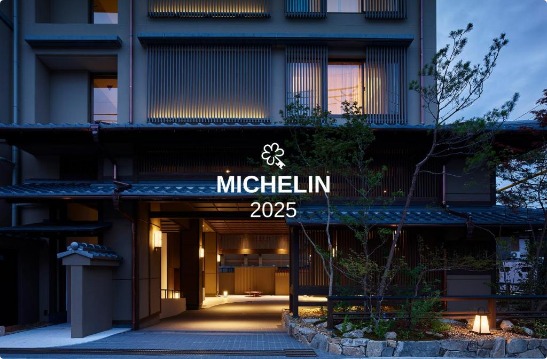
The Celestine sits at a useful price/location intersection — serious enough to count as 5-star-adjacent, affordable enough that you can stay four nights instead of two. 150+ rooms, large public onsen baths (mineral rather than hot-spring), an in-house Japanese restaurant, and a Gion-edge location that gives you a 10-minute walk to Yasaka Shrine without the peak-Gion-street price premium. It won’t match Capella or Shinmonzen on design or staff continuity, but it’s also roughly a quarter of the price. For a first Gion-based Kyoto trip where you want to walk to dinner every night and see the geiko district at 10pm after the day-tourists have gone, it’s the most sensible entry point in this guide. Ask for an upper-floor room to avoid taxi-rank noise.
What’s good:
- 8-minute walk to Yasaka Shrine and the Hanamikoji Street geiko-spotting window
- Public onsen baths (heated mineral rather than genuine spring, but still a plunge bath) are uncommon at this price tier
- A quarter of Capella’s rate for a comparable walk-out Gion location
What’s not:
- Not a serious-design property — functional rather than architecturally memorable
- Lower-floor rooms pick up taxi-rank noise; book high
→ Check prices at Hotel The Celestine Kyoto Gion on Booking.com
Arashiyama Riverside & Heritage
Three properties clustered away from the central-Higashiyama format. HOSHINOYA is its own category entirely. Suiran competes with Mitsui on the Luxury Collection roster but from a riverside base. Seiryu is a heritage conversion east of Gion.
HOSHINOYA Kyoto — Boat-Arrival Riverside Ryokan
Location: Arashiyama, Oi River gorge
Nearest station: Arashiyama (Hankyu line) — arrival is via the hotel’s private boat from a nearby gate
To Arashiyama bamboo grove: 15 min walk
Best for: Retreat stays of 2+ nights; couples; anyone who wants a ryokan-feel with modern service
From: ¥160,000/night
Book: Direct only — hoshinoresorts.com
HOSHINOYA Kyoto sits in the Oi River gorge on the far side of Arashiyama. The property is only reachable by a private boat — the hotel runs a hinoki-cedar shuttle from a small jetty near the Togetsukyo Bridge. Ten minutes on the water; on arrival, the 25 rooms are built into restored buildings that once belonged to the 17th-century merchant Suminokura Ryoi. You walk into a working estate rather than a hotel lobby. Rooms don’t have TVs. They do have heated wood floors, hand-blocked wallpaper, deep cedar soaking tubs, and picture windows onto forested slopes. Kaiseki dinner (Japanese or French options) is the main evening event — HOSHINOYA functions more like a ryokan than a Western hotel. The boat from the Togetsukyo jetty runs 8am to 9pm, so plan day-trips into central Kyoto around that. Two-night minimum most of the year. This is a retreat, not a base. If your Kyoto trip has room for two or three slow nights away from the downtown rhythm, this is the one.
What’s good:
- Boat arrival is functional rather than theatrical — you genuinely cannot drive to the hotel
- Kaiseki dinner (Japanese or French) is the strongest in-hotel dining of any property on this list
- No TVs, no intrusive tech, heated wood floors and cedar tubs — a ryokan format at hotel service standards
What’s not:
- Boat runs 8am to 9pm only — late dinners in downtown Kyoto are a logistical issue
- Two-night minimum most of the year; the hotel is not set up for one-night visits
→ HOSHINOYA Kyoto direct (not on Booking.com)
Suiran, a Luxury Collection Hotel — Arashiyama Private-Onsen Rooms
Location: Arashiyama, Hozu River, next to Tenryu-ji
Nearest station: Saga-Arashiyama (JR Sagano line) — 10 min walk
To Arashiyama bamboo grove: 10 min walk
Best for: Arashiyama-first stays; rooms with private onsen at a more workable price than HOSHINOYA
From: ¥95,000/night
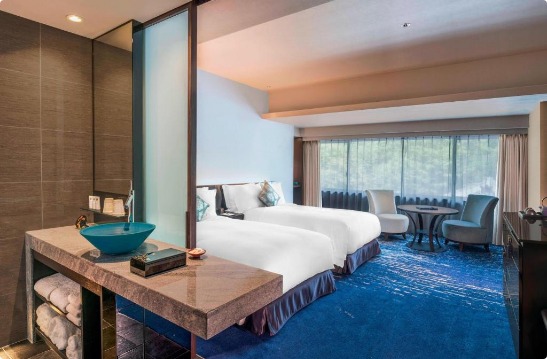
Suiran is Marriott’s Luxury Collection entry in Arashiyama, on the Hozu River next to UNESCO-listed Tenryu-ji. 39 rooms, several in restored century-old villas once built for a local baron, and a chunk of them with private open-air onsen baths fed from natural springs. The property offers a complimentary one-way taxi from Kyoto Station — small detail, but it saves the luggage-on-train hassle Arashiyama usually involves. Café Hassui does an underrated afternoon tea on a river terrace; the evening aperitif is complimentary and the 4pm–6pm window with the river running past is one of the nicer slow moments in any Kyoto hotel. Kyo-Suiran serves washoku with a light French touch, which sounds awful and is in fact good. If HOSHINOYA’s boat format and two-night minimum are off the table, Suiran is the Arashiyama alternative that’s both more flexible and still on Booking.com.
What’s good:
- Private open-air onsen rooms at roughly 60% of HOSHINOYA’s rate
- Complimentary one-way taxi from Kyoto Station is a real logistical win for Arashiyama arrivals
- Walkable to Tenryu-ji and the bamboo grove — early morning before the crowds is the trick
What’s not:
- Not all rooms have private onsen — check the category carefully; you want one of the onsen-equipped suites
- Arashiyama gets genuinely crowded in the middle of the day; late afternoons are quieter
→ Check prices at Suiran on Booking.com
The Hotel Seiryu Kyoto Kiyomizu — 1933 Schoolhouse Conversion
Location: Higashiyama, two blocks from Kiyomizu-dera approach
Nearest station: Kiyomizu-Gojo (Keihan line) — 10 min walk uphill
To Kiyomizu-dera: 7 min walk
Best for: Kiyomizu dawn walks; heritage architecture fans; mid-size luxury
From: ¥85,000/night
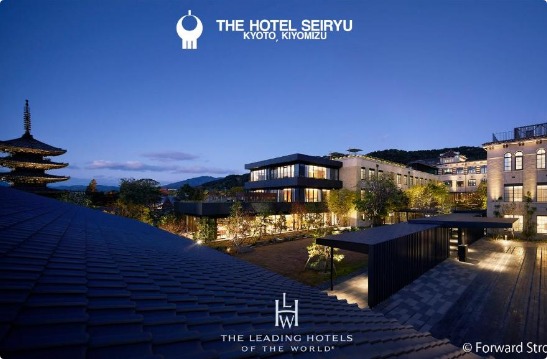
The Hotel Seiryu Kyoto Kiyomizu opened in 2020 inside the shell of the 1933 former Kiyomizu elementary schoolhouse — a Taisho-era heritage building just below the approach to Kiyomizu-dera. Conversion rather than demolition: the tiled facade, blackened beams, entrance hall and original staircases are still there. 48 rooms across heritage and new-build wings — heritage-wing rooms have the better stories, new-build ones have the better baths. Location is the quiet advantage: two blocks below the approach to Kiyomizu-dera means you can be through the temple gate before 7am and back in the hotel for breakfast by 8:30, every day you want to. K36, the rooftop cocktail bar, looks out over Yasaka Pagoda and runs one of the stronger hotel-bar programmes in the city. Leading Hotels of the World member — soft-branded service without the Luxury Collection or Ritz price premium.
What’s good:
- 1933 heritage schoolhouse shell gives the hotel a texture you cannot manufacture new
- 7-minute walk to Kiyomizu-dera means dawn visits before the tour coaches arrive
- K36 rooftop bar looks out at Yasaka Pagoda — a serious sunset spot
What’s not:
- Room sizes and shapes vary wildly between the heritage and new-build wings — specify your preference
- Uphill walk from any station — taxi in with luggage, not walk
→ Check prices at The Hotel Seiryu Kyoto Kiyomizu on Booking.com
Machiya & Countryside Luxury
Three different flavours of stepping away from the standard-format 5-star hotel. Maana is a whole-house machiya rental in town. Moksa is rural-Kyoto retreat. Sumiya Kihoan is a luxury ryokan 30 minutes west in Kameoka.
Maana Kiyomizu — Whole-House Machiya
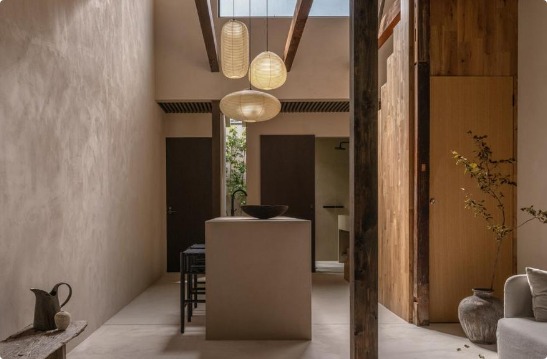
Location: Kiyomizu / Higashiyama
Nearest station: Kiyomizu-Gojo (Keihan line) — 12 min walk
To Kiyomizu-dera: 10 min walk
Best for: Couples or two couples wanting a private-house stay near Kiyomizu-dera
From: ¥110,000/night (whole house, sleeps up to 4)
Maana Homes runs three restored machiya in Kyoto — Maana Kiyomizu (the flagship), Maana Kyoto in Shimogyo, and Maana Kamo on the Kamo River. Each is rented as an entire building rather than a room. Kiyomizu is the standout: a two-bedroom machiya ten minutes on foot from Kiyomizu-dera, private hinoki bath, a small Japanese kitchen, and an inner courtyard garden. You’re not sharing the building with other guests. What makes it a luxury offering rather than a well-decorated Airbnb is the service layer — partial kaiseki in-house dinner option (brought in by a local caterer), twice-daily cleaning, a concierge who’ll book temple visits and restaurant reservations. No lobby, no front desk, no bar. For two couples sharing or a single couple wanting three or four very private nights, it sits at a better trade-off than a Ritz suite. If Kiyomizu is booked (it often is), sister Maana Kyoto in Shimogyo runs the same format. Maana Kamo is better for downtown access.
What’s good:
- You have the whole machiya — two bedrooms, courtyard garden, kitchen — to yourself
- Partial kaiseki in-house dinner by a local caterer; breakfast is genuinely good
- 10-minute walk to Kiyomizu-dera without staying on the tourist-heavy main approach
What’s not:
- No front desk; if you want 24-hour concierge you’d rather have the Ritz
- Not family-friendly for more than 4 people — single-building occupancy limit
→ Check prices at Maana Kiyomizu on Booking.com
Moksa Rebirth Hotel — Mount Hiei Countryside
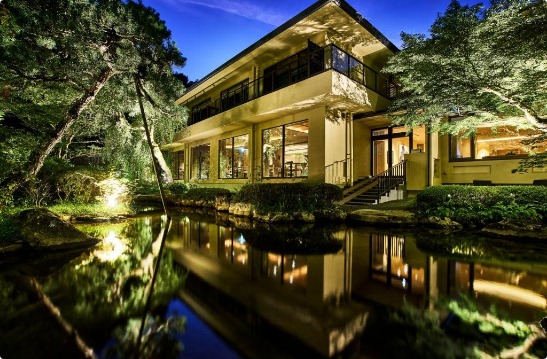
Location: Yase village, at the base of Mount Hiei (northeast rural Kyoto)
Nearest station: Yase-Hieizan-guchi (Eizan line) — 5 min walk
To central Kyoto: 25 min by train via the Eizan line
Best for: Mount Hiei retreat stays; slow-pace trips; Buddhism-focused travel
From: ¥70,000/night
Moksa Rebirth Hotel is the rural-Kyoto outlier on this list. It sits in Yase, the village at the base of Mount Hiei that’s one of the founding sites of Japanese Buddhism — sweeping forested slopes, rushing ravines, moss-covered steps leading to old temples. The 31-room hotel is a clean-lined contemporary building with a large circular cut-out entrance that reinterprets traditional tea-room architecture. An airy lobby with a tea counter, contemporary art, and walls of glass framing a 60-year-old garden from the previous residence on the site. The 25-minute Eizan Railway ride from Demachiyanagi is part of the experience — you’re deliberately not staying in central Kyoto. Meals use local Ohara and mountain ingredients; the spa leans into Mount Hiei’s ascetic Buddhist context. If you want a retreat element inside a Kyoto trip and HOSHINOYA or Aman are booked or over-budget, this is the alternative.
What’s good:
- 25-minute Eizan train ride from downtown — you’re genuinely outside the tourist corridor without being hours away
- Restored 60-year-old garden that the hotel built itself around rather than paving over
- Proper retreat format — slow meals, long baths, minimal WiFi demands — at a much lower rate than Aman or HOSHINOYA
What’s not:
- You’re 25 minutes from anything — not a walk-to-dinner location
- Eizan line stops running earlier than JR; plan your train day-trips with evening buffer
→ Check prices at Moksa Rebirth Hotel on Booking.com
Ryokan Sumiya Kihoan — Countryside Luxury Ryokan, Kameoka
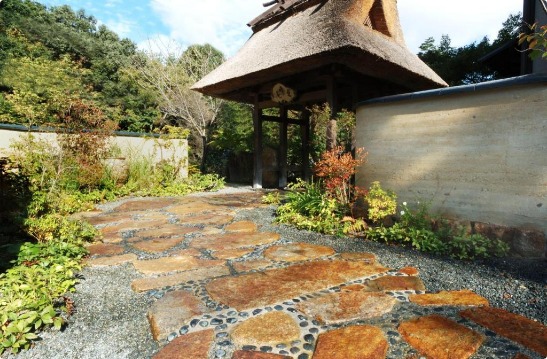
Location: Kameoka, 30 min west of Kyoto by train
Nearest station: Kameoka (JR Sagano line) — 5 min by hotel shuttle
To central Kyoto: 30 min by train
Best for: A one-night countryside ryokan detour paired with a central Kyoto base
From: ¥55,000 per person (includes dinner and breakfast)
Sumiya Kihoan is a proper luxury ryokan in Kameoka — 30 minutes west of Kyoto on the JR Sagano line. A modern rebuild of an older ryokan on a hillside with 14 suites, each with a private outdoor hot-spring bath fed from the ryokan’s own natural source. Kaiseki dinner has multiple Michelin mentions — served in private dining rooms that look over the hillside and, in autumn, onto yellow and red maples. Paired with a night back at a central Kyoto base, Sumiya Kihoan is the most practical way to slot a real luxury-ryokan hot-spring experience into a city-focused trip without committing to the three-hour rail journey to Kinosaki or Hakone. The rail connection is frequent; the hotel runs a shuttle from Kameoka station. If your budget has room for a single-night ryokan detour, this is the easiest way to do it from Kyoto.
What’s good:
- Real hot-spring water in a private outdoor tub in every suite — the Kyoto-region equivalent of a Hakone room-onsen stay
- Kaiseki dinner has multiple Michelin mentions; worth the detour for the meal alone
- 30-minute train to Kyoto Station means you don’t lose half a day to getting there and back
What’s not:
- Kameoka is quiet in the evenings — you’re not leaving the ryokan for dinner or a bar crawl
- One-night stays work but two-night stays don’t — there isn’t much in walking distance beyond the ryokan itself
→ Check prices at Ryokan Sumiya Kihoan on Booking.com
What Most Luxury Guides Get Wrong
Three takes I think the typical “best luxury hotels in Kyoto” round-up buries or gets wrong entirely. None of this is to trash the flagship hotels — they’re all genuinely good properties. It’s to push back on the shortcut advice.
The Ritz-Carlton isn’t automatically the right first Kyoto luxury stay. It’s the default answer because it’s the biggest brand and the highest-rack-rate hotel in the city. But the Ritz gives you perfect urban 5-star hotel service you could get in 20 other cities worldwide — the things that actually make Kyoto different (the gardens, the neighbourhood geography, the ryokan-format service) show up more clearly at Four Seasons, Hotel The Mitsui, HOSHINOYA or The Shinmonzen. If this is your first Kyoto, pick by the thing you came to Kyoto for, not by the brand you know.
Banyan Tree’s isolation is either a feature or a bug — you need to know which before you book. Every guide praises the funicular arrival and the hilltop sunset view. Nobody mentions that you’ll eat at the hotel four nights out of five because getting to Gion for dinner is a 25-minute round trip each way. If your plan is two or three slow days of temple-visiting and hillside walks, that’s an upside. If your plan is dinners in Pontocho and late drinks in Gion, Banyan Tree will make your trip harder than it needs to be. Pick the Ritz or Capella instead.
Aman isn’t more “Kyoto” than the Ritz — it’s more Aman. The brand-loyalist assumption is that a quiet forest property with moss gardens and tatami rooms is closer to “real Kyoto” than an urban Western-brand flagship. It isn’t. The Ritz sits right on the Kamo River, the lifeblood of central Kyoto — Aman sits in a shaped woodland garden north of the city that could, architecturally, sit outside Kyoto and still feel the same. Aman is a brilliant hotel and an extraordinary experience. But what it offers is the Aman experience applied in Japan, not a deeper Japan experience. If you want the latter, stay at HOSHINOYA or a proper ryokan like Hiiragiya or Tawaraya — see my Kyoto ryokan guide for those.
Aman’s 72-acre claim is off. The hotel cites a 7.2-hectare estate — roughly 18 acres, not 72. I’ve seen the larger figure copied across several guides and it’s a conversion error. It’s still a huge property by Kyoto standards, but you’re walking 18 acres of forest, not 72.
Which Hotel for Which Trip
Matched to specific traveller types rather than the generic “best for couples” summaries:
- Honeymoon — classic version: Park Hyatt Kyoto, upper-category west-facing room for the Yasaka Pagoda view.
- Honeymoon — retreat version: HOSHINOYA Kyoto, two-night minimum; Aman Kyoto if HOSHINOYA is unavailable.
- Anniversary / milestone: The Ritz-Carlton Kyoto, river-view Deluxe. Polished service is the thing you’re paying for and it lands hardest here.
- Garden-first: Four Seasons Hotel Kyoto, Shakusui-en-pond-view room. Aman Kyoto for the garden alternative.
- Design-first: The Shinmonzen (Tadao Ando, nine rooms, direct-book). Alternative: Hotel The Mitsui Kyoto (André Fu).
- Onsen-first: Roku Kyoto LXR for private in-room onsen. Runner-up: Ryokan Sumiya Kihoan for a single-night detour.
- Slow retreat / Buddhism-leaning: Moksa Rebirth Hotel in Yase, or Aman Kyoto in Takagamine.
- Couples under ¥100,000/night: Hotel The Mitsui Kyoto or Saka Hotel. Mitsui for onsen and larger rooms; Saka for the smaller scale.
- Family with teens: Four Seasons Hotel Kyoto — one of the more family-workable footprints among the big-brand set. Alternative: Hotel The Mitsui.
- Solo luxury: The Shinmonzen or Maana Kiyomizu. Small enough that you won’t feel conspicuous.
- Two couples together: Maana Kiyomizu (two-bedroom whole-machiya rental). Better value than two Ritz rooms.
- Arashiyama-first: Suiran for Booking.com availability with private onsen rooms; HOSHINOYA for the full boat-arrival version.
- Kiyomizu-dera morning walks: The Hotel Seiryu Kyoto Kiyomizu or Saka Hotel — both 5–7 minutes on foot from the temple gate.
Frequently Asked Questions
What’s the best 5-star hotel in Kyoto?
There isn’t a single answer. Pick by axis: Four Seasons wins on garden; Park Hyatt on view; Ritz on polished urban service; Aman and HOSHINOYA on retreat format; The Shinmonzen on design. For a first-time Kyoto visitor I’d pick Hotel The Mitsui Kyoto for the combination of real onsen, larger rooms, and a central-enough location.
Is Aman Kyoto worth it?
If you value the Aman experience — long-tenure service, complete quiet, forest silence, slow mornings — yes. If you value proximity to central Kyoto, walk-to-dinner convenience, or a specifically Kyoto-architectural experience, probably not. HOSHINOYA gives you more of the latter at roughly 60% of the rate. Aman is a brilliant hotel that happens to be in Kyoto, not one defined by Kyoto.
Which luxury hotels in Kyoto have real onsen?
Four: Hotel The Mitsui Kyoto (piped from Arima Onsen), Roku Kyoto LXR (on-site well in Kinugasa), Suiran (natural springs in Arashiyama), and Ryokan Sumiya Kihoan (on-site source in Kameoka). Aman Kyoto also has a spring-fed onsen pool in its bathhouse. Most other “hotel onsens” in central Kyoto are heated mineral baths rather than genuine hot-spring water.
How far ahead do I need to book luxury Kyoto hotels for cherry-blossom season?
For late March to early April at the Ritz-Carlton, Four Seasons, Aman, HOSHINOYA and The Shinmonzen: nine months. The two peak-sakura weekends genuinely sell out that far out. For smaller boutiques (Saka, Seiryu, Maana): six months. For mid-tier luxury (Celestine, Capella, Six Senses): four to six months. Weekday nights book later than Friday–Saturday — anchor midweek if flexible.
What’s the best hotel for a honeymoon in Kyoto?
Three answers depending on preference. Park Hyatt Kyoto if the pagoda view is the thing that matters. HOSHINOYA Kyoto if you want the quiet, boat-arrival, retreat version. The Shinmonzen if design and staff continuity are the priority. I’d avoid the Ritz for a honeymoon specifically — the service is faultless but formal, and honeymoons tend to want warmer personality than a big-brand flagship delivers.
Is HOSHINOYA Kyoto on Booking.com?
No. HOSHINOYA Kyoto is direct-only via hoshinoresorts.com. Same goes for Aman Kyoto (aman.com) and The Shinmonzen (theshinmonzen.com). Booking.com has the other 15 hotels on this list.
Which luxury Kyoto hotels have Michelin-starred restaurants?
Mizuki at The Ritz-Carlton is Michelin-starred for kaiseki. Sushi Wakon at the Four Seasons holds a star for sushi. Kyoyamato at Park Hyatt runs a kaiseki service in a 360-year-old teahouse with Michelin recognition. HOSHINOYA’s kaiseki programme is Michelin-recommended. Capella Kyoto has SoNoMa by SingleThread (SingleThread California is three-starred; the Kyoto outpost is too new to be reviewed). Sumiya Kihoan has multiple Michelin mentions.
What’s the best garden hotel in Kyoto?
Four Seasons Hotel Kyoto for the heritage Shakusui-en pond garden. Aman Kyoto for the forest-scale moss garden. Hotel The Mitsui Kyoto for the surviving old maple and the Nijo Castle moat view. HOSHINOYA Kyoto for the old-estate riverside gardens. If garden is the single reason for your trip, book Four Seasons pond-view or Aman. Everything else is one step down.
What to Read Next
For the broader “which Kyoto neighbourhood should I stay in” question, the main Kyoto hotel guide covers six districts and three budget tiers. For a proper ryokan-format stay rather than a hotel, the Kyoto ryokan guide covers ten including historic flagships like Hiiragiya and Tawaraya. If real hot-spring water is the priority, the Kyoto onsen hotels guide lists the genuine onsen properties in and around the city. If you’re specifically basing in Arashiyama — where HOSHINOYA and Suiran sit — the Arashiyama hotels guide has the local picture. For cherry-blossom forecasts and festival dates, the Kyoto City Tourism Association is the authority.