Kyoto after dark has a food route. This tour is built around the city’s nighttime economy, from geiko-world etiquette to how evening entertainment evolved into today’s hostess clubs. You also get a guided walk that connects what you’re seeing on the streets with why people care about it.
I especially like the two staged meal stops at small local bars/restaurants. The portions are aimed to satisfy without turning your evening into a food coma, and you’ll get a mix of regionally representative dishes plus one drink at each place. One thing to keep in mind: expect solid walking, and at least one stop is set up like a bar, so group chatting can be a little harder than at a sit-down table.
In This Review
- Key highlights that make this Kyoto night tour worth it
- Gion after dark: why the streets feel different at night
- Where to start: timing, meeting point, and pacing that works
- The Gion lesson: geiko, the etiquette, and the entertainment evolution
- Dinner by locals: how the meal stops actually feel
- Wandering Pontocho, Kiyamachi, and Kawaramachi St. after 8:15
- Second restaurant stop: the last round of food and drink
- Drinks, age rules, and what you should plan for
- Value check: is $119 fair for a Kyoto night out?
- Who this tour suits best (and who might want a different plan)
- Should you book the Kyoto Nighttime All-Inclusive Eats and Streets tour?
- FAQ
- FAQ
- What is the duration of the Kyoto night food tour?
- What’s included in the price?
- Where does the tour start and end?
- Is it suitable for vegetarians?
- How old do you need to be to join?
- What happens if the weather is bad?
Key highlights that make this Kyoto night tour worth it

- Gion first, then the “after hours” streets on the west side of the Kamogawa River, including Pontocho and Kiyamachi
- Geiko vs geisha explanation plus real context on how entertainment culture changed over time
- Two drink moments included, alcoholic or non-alcoholic, with choices like beer or sake/shochu depending on the stop
- Small group pace (max 6 travelers) that keeps the storytelling flowing and the food order moving
- Dietary needs handled in advance, including vegetarian options and support seen for gluten-free requests
- Vetted restaurants you’d miss if you were just wandering by yourself
Gion after dark: why the streets feel different at night

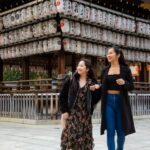
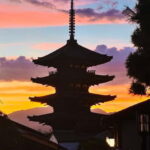
Kyoto looks polished in daylight. At night, it feels more human—still elegant, but with a pulse you can’t miss. This tour times things so you start in Gion as the evening show starts, then you move across and along the Kamogawa so the vibe shifts street by street.
The big value here is that you’re not just sightseeing. Your guide frames what you’re walking past: why certain neighborhoods have their own rules, what people mean when they talk about geiko, and how the city’s “evening economy” became what you see today. Guides like Hugo and Laura come up in the experience again and again for mixing practical explanations with a fun tone.
And yes, you’ll see the kinds of streets where Kyoto people clearly want to protect tradition. But you’ll also notice the parts where young nightlife energy shows up just a couple blocks away. That contrast is hard to notice on your own unless you know where to look.
A few more Kyoto tours and experiences worth a look

Where to start: timing, meeting point, and pacing that works

You meet at Minamiza Theater in Gion at 6:30pm. It’s an easy area to orient yourself because you’re already in the district that most people first picture when they think Kyoto nights. From there, the walk starts before things get fully dark, which matters for comfort and first impressions.
The tour runs about 3 hours and stays walk-focused: you’ll move between neighborhoods, and you’ll have food breaks that are scheduled like checkpoints. In practice, that pacing is why the evening doesn’t drag. Multiple guides are praised for keeping it moving—one guest even noted that the whole thing felt like it flew by.
Still, here’s the consideration: this is not a “sit-and-watch” tour. Expect a decent amount of walking. If you know your legs get angry after dinner, wear good shoes and plan to go slow on stairs and narrow lanes.
The Gion lesson: geiko, the etiquette, and the entertainment evolution
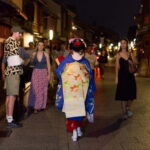
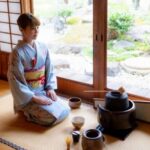
The first stretch is an educational walk through Gion, on the east side of the Kamogawa River. Your guide explains why people in Kyoto often say geiko instead of the broader word geisha. The point isn’t just vocabulary. It’s about how local culture labels and protects a specific world of performing arts.
You’ll also get a plain-language explanation of how evening entertainment evolved—how older forms of entertainment and social traditions connect to the hostess club culture you’ll hear about today. The goal is to help you understand what you’re seeing without treating it like a museum display.
One extra detail I like about this part: it’s written for people who might be nervous about “not knowing the rules.” When your guide explains what’s normal, you stop worrying and start watching more confidently. If you want photos, note that some guests wish the tour began earlier so they could photograph streets a bit before it gets dark. You still get great night atmosphere, just know the lighting is evening lighting, not golden-hour daylight.
Dinner by locals: how the meal stops actually feel

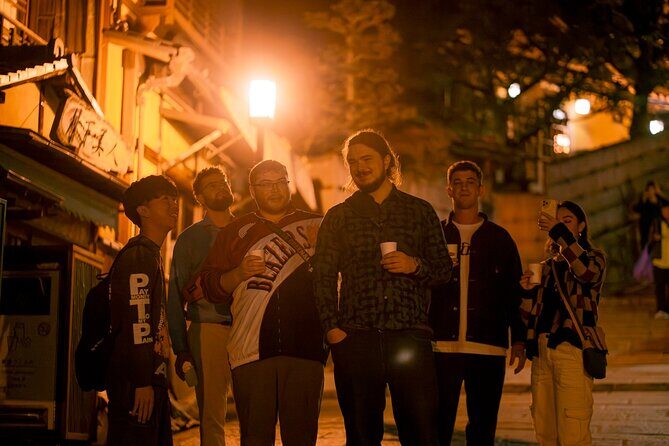
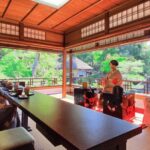
Around 7:30pm, the tour shifts from storytelling to eating. This is where you sample regionally representative dishes at standing bars and small restaurants—the kind of places that are lively, narrow, and clearly part of daily life.
What I like about the structure is that it’s flexible. You can usually choose a drink style—think beer as the baseline, with options to swap for sake or shochu if you prefer. The important bit is that the drinks are included, not added on as surprise costs.
Dietary needs are handled with attention. Vegetarian guests are explicitly accommodated, and one review highlights help for gluten-free needs through the guide’s communication with the restaurant. That doesn’t mean every dish is guaranteed identical anywhere in Japan, but it does mean the tour doesn’t treat dietary restrictions like an afterthought.
One more practical note: standing-bar settings are part of the fun, but they can affect your comfort. If you dislike loud rooms, cramped seating, or quick service, this might not be your favorite format. The tour does its best to make it work, and overall reviews are positive about the pacing and amount of food.
Wandering Pontocho, Kiyamachi, and Kawaramachi St. after 8:15

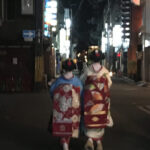
After you eat, you cross to the west side of the Kamogawa and keep walking through some of Kyoto’s most recognizable night streets: Pontocho, Kiyamachi, and the Kawaramachi St. area. This is where the tour shows you how Kyoto blends protection of tradition with a clear taste for the present.
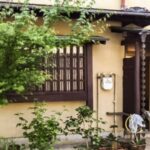
Pontocho’s narrow lanes are the star for atmosphere. The tour’s framing helps you understand why people respect those old narrow streets: not just because they look pretty, but because they’re part of how the neighborhood functions socially. Then you’ll also see the newer, more youth-leaning areas nearby. That shift is subtle at first, but your guide helps you notice it.
In a good walking tour, you stop treating the street as scenery and start reading it like a map. That’s what this segment does. You’re not just moving between photo spots. You’re learning how Kyoto night life clusters, changes tone, and then resets.


Second restaurant stop: the last round of food and drink

Sometime around 9:00pm, the tour visits another vetted place. This stop is built to round out the meal and keep the evening satisfying. You’ll likely get more of the kinds of flavors Kyoto does best—small plates and comfort-forward choices that work with alcohol or non-alcohol beverages.
Then, around 9:30pm, you finish near Kyoto-Kawaramachi Station, leaving you in an area with enough energy to continue on your own if you want. This ending matters. You’re not stuck at a dead-end with nowhere to go, and you’re not far from other nightlife or transit.
One detail that comes up in reviews is that the second restaurant can be arranged like a bar, which may make group conversation tougher. If you’re traveling with friends who want long chats, I’d treat this as a “close the loop on food and atmosphere” moment rather than a talk-around-the-table dinner.
Drinks, age rules, and what you should plan for

The tour includes two beverages total—one at each restaurant. You can choose alcoholic or non-alcoholic options, but alcohol in Japan is not for underage visitors. The minimum drinking age in Japan is 20, and the experience itself is 13+.
So what’s the smartest plan? If you’re under 20 or prefer not to drink, you can still fully enjoy the structure. Your guide and the restaurants build the night around the included drink anyway, and you can keep the focus on the food and the streets.
Also, don’t assume you’ll get unlimited refills. The tour is designed around two included beverages, and any extra drinks can be purchased directly at the restaurants if you want.
Value check: is $119 fair for a Kyoto night out?

At $119 per person, you’re paying for four things at once: guided walking across key neighborhoods, dinner at multiple stops, the cultural context that makes the streets make sense, and the built-in drink component.
If you’re thinking like a practical traveler, here’s the value logic: two drinks plus a dinner isn’t cheap in Kyoto, especially in central areas. Add a guide who can translate the cultural “why” behind geiko etiquette and Gion’s layout, and you’re not just buying meals—you’re buying time saved and confusion avoided.
That’s also why the ratings stay high. The experience is praised for being well-paced and for restaurant choices that you probably wouldn’t find without help. Even some critical notes are about specific restaurant quality or seating arrangement, not that the overall concept is off.
The single best way to judge value is simple: if you want a first-night-style orientation to Kyoto’s nighttime economy and you’re okay with a walk-and-eat schedule, this price is in the workable zone.
Who this tour suits best (and who might want a different plan)
This works especially well for:
- First-time visitors who want a Gion-centered intro without getting lost
- Food-focused travelers who like izakaya-style pacing
- People who enjoy cultural context, not just landmarks
- Anyone traveling with a small group who wants a guide-led flow
It may be less ideal if:
- You dislike walking at night or have low tolerance for cramped bar seating
- You’re looking for a fully seated, long-dinner experience with lots of space
- You’re sensitive to smoking. One note from the tour’s own guidance says smoking can happen occasionally in Japan, and it’s rare but possible for it to be more noticeable than you’d like.
If you do book, bring a calm mindset. This isn’t a sit-down “show dinner.” It’s a guided night out that treats the streets and food as part of the same story.
Should you book the Kyoto Nighttime All-Inclusive Eats and Streets tour?
If you want your first Kyoto night to make sense fast, I think you’ll like this. You get the Gion streets you came for, but you also get the explanations that help the neighborhood feel less mysterious. You’ll eat real local food in places that match the atmosphere, and you won’t be guessing how many stops or drinks to expect because the structure is fixed.
My “yes, book it” test is this: you’re comfortable walking for about three hours and you like the idea of dinner happening at small bars/restaurants. If that sounds like your style, this is a strong pick for a first night.
FAQ
FAQ
What is the duration of the Kyoto night food tour?
It lasts about 3 hours.
What’s included in the price?
The tour includes dinner and two beverages total, with one drink at each restaurant. Alcoholic or non-alcoholic options are offered.
Where does the tour start and end?
It starts at Minamiza Theater in Gion (6:30pm) and ends at Kyoto-Kawaramachi Station.
Is it suitable for vegetarians?
Yes, vegetarian dietary restrictions are accommodated.
How old do you need to be to join?
All participants must be 13+. If you plan to drink alcohol, note that Japan’s minimum drinking age is 20.
What happens if the weather is bad?
This experience requires good weather. If it’s canceled due to poor weather, you’ll be offered a different date or a full refund.
If you want, tell me your travel dates and whether you’re vegetarian or avoiding alcohol, and I’ll suggest what to prioritize when you’re planning the rest of your Kyoto evening.