Three Kyoto icons, one efficient morning. This half-day tour is built for people who want the big-name sights without wasting hours figuring out routes. You get a guided sweep through Nijo Castle and the Golden Pavilion, plus the Kyoto Imperial Palace area, with entrance fees and rides handled for you.
I also like how the tour keeps momentum moving between sites. The downside is the schedule can change: Kyoto Imperial Palace (and sometimes Nijo Castle) can be closed, and the tour swaps in an alternate site, so plan your must-sees around the day.
In This Review
- Key takeaways before you go
- A fast Kyoto triangle: Nijo, Kinkakuji, and the Imperial Palace
- Price and time: what $87.19 gets you (and what it doesn’t)
- Where you meet, and how the tour flows through Kyoto
- Stop 1: Nijo Castle’s Tokugawa layout and gilded interiors
- Stop 2: Kinkakuji Golden Pavilion and pond-side design
- Stop 3: Kyoto Imperial Palace—what you see, and what changes on closed days
- Pace, crowds, and hearing your guide: how to make it enjoyable
- Comfort and logistics: riding between Kyoto’s highlights
- Who this tour is best for (and who should skip it)
- Should you book this Kyoto morning highlights tour?
- FAQ
- FAQ
- How long is the Kyoto morning highlights tour?
- What are the main stops on the tour?
- Are admission tickets included?
- Is food or drinks included?
- Where do I meet the tour in Kyoto?
- Will I get dropped off back at the same place?
- Is hotel pick-up included?
- What happens if the Kyoto Imperial Palace is closed?
- What happens if Nijo Castle is closed?
- How big is the group?
- Can I cancel for a full refund?
Key takeaways before you go
- Three UNESCO-linked stops in one morning with set time at each place (about 50/45/40 minutes).
- Admission fees are included, so you’re not hunting tickets while the clock runs.
- Air-conditioned vehicle between landmarks, helpful in Kyoto’s muggy or chilly stretches.
- Nijo and Kinkakuji are structured for quick viewing, but you’ll still do real walking and standing.
- Expect substitutions on closed days, including Kitano Tenmangu Shrine or Ryoan-ji Temple depending on what’s shut.
A fast Kyoto triangle: Nijo, Kinkakuji, and the Imperial Palace
This tour is basically a smart shortcut through Kyoto’s “greatest hits.” In under five hours, you hit three of the city’s most famous UNESCO World Heritage–linked sights, and you don’t have to map out the logistics between them. That matters in Kyoto, where crowds build quickly and transit can eat your morning.
The three stops are also different enough that the time doesn’t feel like a repeat. You start with the Tokugawa-era world of Nijo Castle (power, design, and ceremonial spaces). Then you pivot to the glamour and stillness of Kinkakuji Temple, where the gold pavilion rises above a pond. Finally, you shift to imperial Japan with the Kyoto Imperial Palace grounds and interior highlights—simple by comparison, but tightly tied to the story of Japan’s seat of authority.
The real value is that you’re not doing this as three separate day trips. A guide stitches the sites together with context, and the bus handles the between-stop travel so you can keep your brain focused on what you’re seeing, not where you’re going next.
A few more Kyoto tours and experiences worth a look


Price and time: what $87.19 gets you (and what it doesn’t)
At $87.19 per person, you’re paying for convenience: a licensed English guide interpreter, admission fees, and transportation in an air-conditioned vehicle. For a first-time Kyoto visit, that can be a good deal because the alternative is piecing it together yourself—figure out transit, buy tickets, and then try to match open times.
What you’re not buying is a slow, linger-all-morning experience. The tour is time-managed: Nijo Castle gets about 50 minutes, Kinkakuji about 45 minutes, and the Kyoto Imperial Palace about 40 minutes (with some flexibility depending on the day). That’s enough to see the highlights, take photos, and understand what you’re looking at. It’s not enough to become the kind of person who wants to sit in one garden and watch the clouds drift by for an hour.
Also, food and drinks aren’t included. Plan to eat either before you start or right after you’re dropped back near Kyoto Station. If you’re coming from Osaka, you’ll also want to treat this as a morning plan, not a full-day meal routine.
Where you meet, and how the tour flows through Kyoto
The start point is Kyoto Avanti, 31 Higashikujō Nishisannōchō, Minami Ward, and the tour ends at the same spot—in front of Kyoto Avanti, across from Kyoto Station Hachijo Exit.
That’s a big practical plus. Kyoto Station is easy to find, and Hachijo Exit is one of the more straightforward landing points. It also means you can use this tour as a “get oriented” move: you finish back where transit and dinner options are waiting.
A couple of details matter for your planning:
- The tour caps at 40 travelers, and seats may not be designated.
- The order can change based on road conditions and congestion, so don’t build your whole morning around a single perfect sequence.
- You’ll be on foot inside each site for the time allotted, so comfortable shoes are not optional.
There’s also a mobile ticket involved. That’s helpful in a place where lines and last-minute ticket checks can be stressful. Just make sure your phone battery stays alive.
Stop 1: Nijo Castle’s Tokugawa layout and gilded interiors
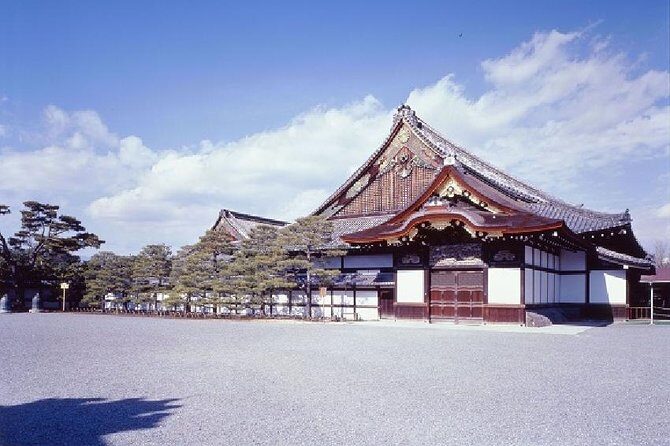
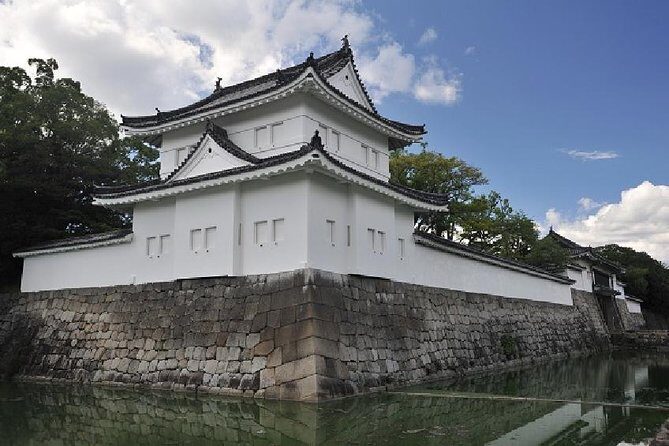
Nijo Castle is the grand opener. Built on the orders of Tokugawa Ieyasu in 1603, it’s a UNESCO World Heritage site tied to the Tokugawa shogunate. The castle complex is known for its elegant construction and striking interiors, including multiple structures connected together and key rooms decorated in dramatic ways.
In your allotted time, you’re focusing on the areas that give you the best “wow per minute.” The tour highlights the Ninomaru Palace as a must-see, especially for the elaborate carvings and decorations. You also get a sense of how the spaces were designed for authority and control—cypress wood structures, gold leaf–covered living quarters, and functional areas like the kitchen and guardhouse.
A smart expectation: this stop is architectural and spatial, not just scenery. If you want to feel the story behind the walls, being in a guided group helps. You’ll also get the context fast enough that the castle stops feeling like random rooms and starts feeling like a system.
One caution: there are days when Nijo Castle is closed, especially Tuesdays during certain months and during a date range around late December through early January. If that happens, the tour doesn’t cancel your day—it swaps in Ryoan-ji Temple instead. If Nijo is your main reason for booking, check closure timing before you commit.
Stop 2: Kinkakuji Golden Pavilion and pond-side design
Then you move to Kinkakuji Temple, where the “Golden Pavilion” nickname is earned. This is one of Kyoto’s most popular temples, and the key visual is the wooden structure covered in thin layers of pure gold. It sits in a setting shaped for reflection, with a pond that changes how the pavilion feels depending on your angle and the light.
Your time here is about 45 minutes. That sounds short, but it works because the site is structured for one-direction movement. You’ll spend that time doing three things:
1) spotting the pavilion’s architectural details,
2) taking in the pond views,
3) absorbing what the guide explains about the design choices.
A practical note from real-world experience: this is a place where crowds can stack up fast, and circulation routes can include uneven steps and a bit of uphill effort. If you’re traveling with sore feet or you dislike stair climbs, bring the right shoes and accept that this is “active sightseeing,” not a sit-and-stare stop.






Stop 3: Kyoto Imperial Palace—what you see, and what changes on closed days
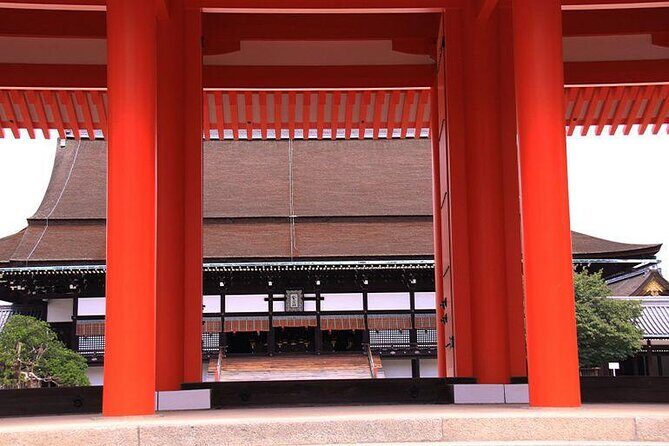
The final stop is Kyoto Imperial Palace. It was used as the emperor’s residence until about 150 years ago, and your visit focuses on the former ceremonial site of imperial enthronement and the restrained design of interior spaces.
This part of Kyoto often surprises people, because it feels less flashy than the other two stops. Instead of gold and dramatic castle interiors, you get a sense of formality and simplicity—an imperial mindset translated into architecture and space. In about 40 minutes, you can still gather a lot of meaning if you listen to the guide’s framing.
Here’s the big scheduling reality: Kyoto Imperial Palace is closed to visitors on Mondays and also on the following day if Monday is a holiday. It’s also closed on days when there is an Imperial Household Agency event. If the palace is closed, the tour visits Kitano Tenmangu Shrine instead.
There’s an extra wrinkle too: if the closed day falls on the 25th, the replacement is Nishi Hongan-ji Temple. And if you were counting on Nijo and Kinkakuji as Plan A, that’s fine. But if your “must-see” is the Imperial Palace itself, you’ll want to match your travel dates to opening days.
This is the main reason I tell people to read the closure rules before they book. The tour is still a good morning, but it’s not guaranteed to deliver all three exact listed stops on every departure date.
Pace, crowds, and hearing your guide: how to make it enjoyable
This tour is efficient. That’s the point. But efficient also means quick transitions. Some parts will feel slightly rushed if you’re the type who wants to linger at every photo spot.
Crowds can make it harder to hear your guide in the busiest areas—especially at Kinkakuji and around circulation points. Even with a guiding setup, sound can get tangled when multiple groups talk at once, and when you’re not standing in the front.
Here’s what helps:
- If you’re sensitive to sound, bring small earphones so you can hear any guidance you’re given more clearly.
- Stay closer to the front half of the group when possible. If you drift to the back, you’ll spend more time thinking about where the guide is than about what you’re looking at.
- Keep your expectations realistic: this is a highlights tour, not a slow museum day.
On the plus side, the guide role really shapes your experience. I’ve seen guide names like Casey (KC), Jessie, Jun, and Mr. Harada paired with praise for being funny, organized, and strong on history and practical navigation. If you get a guide like that, the tour feels like a story with three chapters instead of a checklist.
Comfort and logistics: riding between Kyoto’s highlights
One of the most comfortable parts of this plan is the between-stop transportation. You’ll ride in an air-conditioned vehicle, which is genuinely helpful in Kyoto when weather changes fast. You also save time because the route planning is handled, which is nice when morning crowds hit.
The group limit—40 people—keeps things from turning into a stampede. Still, you’ll want to move with purpose at each site. The tour is built around scheduled stop times, so bathroom breaks and long photo detours can eat into your sightseeing.
At the end, you’re dropped back at Kyoto Station near the Kyoto Avanti area. That makes it easy to pivot to shopping, a coffee, or another temple visit on your own.
Who this tour is best for (and who should skip it)
This is a great fit if:
- You’re short on time in Kyoto and want a first overview.
- You prefer guided context so the architecture and ceremonies make sense quickly.
- You want admissions and transportation bundled into one plan.
- You’re traveling from Osaka and want an organized morning option.
It might not be your best choice if:
- You’re traveling on a day when the palace is closed and you consider Kyoto Imperial Palace non-negotiable.
- You dislike crowds or stairs and want a slower, more flexible pace.
- You want to spend long stretches in gardens without interruption.
Also, keep an eye on the walking intensity. Even with bus transportation, each stop involves active movement, and the tour is designed to cover a lot of ground in a short window.
Should you book this Kyoto morning highlights tour?
If you want a solid introduction to Kyoto’s power centers—castle, temple glamour, and imperial space—this is a good use of your morning. The $87.19 price makes sense when you factor in the guide interpreter, admission fees, and air-conditioned transport.
I’d especially recommend it if you’re doing Kyoto as a first stop (or a one-day Kyoto hit) and you’d rather not worry about ticket lines and between-site routing. But if Kyoto Imperial Palace is your top goal, check the closure rules for your exact day first. A swapped-in shrine can still be beautiful, but it won’t replace what you planned to see.
FAQ
FAQ
How long is the Kyoto morning highlights tour?
It runs about 4 hours 40 minutes.
What are the main stops on the tour?
You visit Nijo Castle, Kinkakuji Temple (Golden Pavilion), and the Kyoto Imperial Palace area.
Are admission tickets included?
Yes. Admission fees are included for the tour stops.
Is food or drinks included?
No. Food and drinks are not included.
Where do I meet the tour in Kyoto?
You meet at Kyoto Avanti (31 Higashikujō Nishisannōchō, Minami Ward). The tour starts and ends in front of Kyoto Avanti, across from Kyoto Station Hachijo Exit.
Will I get dropped off back at the same place?
Yes. The tour ends in front of Kyoto Avanti (Kyoto Station Hachijo Exit area).
Is hotel pick-up included?
No. Hotel pick-up and drop-off are not included.
What happens if the Kyoto Imperial Palace is closed?
On days when the palace is closed to visitors, the tour visits Kitano Tenmangu Shrine instead. If the closed day is the 25th, it visits Nishi Hongan-ji Temple instead.
What happens if Nijo Castle is closed?
On days when Nijo Castle is closed (including certain Tuesday closures in specific months and a late-December to early-January period), the tour visits Ryoan-ji Temple instead.
How big is the group?
The tour has a maximum of 40 travelers.
Can I cancel for a full refund?
Yes. Free cancellation is available up to 24 hours before the experience’s start time for a full refund.